Natural Family Planning Physician — Guiding your health and fertility journey
HomeAboutNFP MethodsBlogResourcesContactSubscribe
NFP Physician

Guiding your health and fertility journey

Education on Natural Family Planning, cycle health, and fertility from a board-certified, NaProTechnology-trained family medicine physician.

Explore

  • NFP Methods
  • Blog
  • Resources
  • About
  • Contact

Start Here

  • What is NFP?
  • Choosing a method
  • Getting started
  • Irregular periods

Connect

  • Instagram @nfpphysician
  • Facebook
  • Email me

Disclaimer: The information provided on this site is for educational purposes only, and does not substitute consultation with a qualified and licensed physician or medical care provider.

This post may include affiliate links. If you click one of them, I may receive a small commission at no extra cost to you. Thank you for your support!

© 2026 Natural Family Planning Physician. All rights reserved.

  1. Blog
  2. /
  3. The Basics

When Can a Woman Get Pregnant?: Using NFP to Track Your Fertile Window

Dr. Rachel Regan·January 5, 2024·1 min read
When Can a Woman Get Pregnant?: Using NFP to Track Your Fertile Window

Myths and Facts …

MYTH: Women can get pregnant any day of their cycle.

FACT: Pregnancy is only possible during the fertile window around ovulation.

What is the Fertile Window?

The fertile window refers to the period in the menstrual cycle when a woman is most likely to get pregnant. It is determined by the lifespan of both the sperm and the egg once ovulation occurs.

Duration of the Fertile Window

Typical Length: The fertile window lasts about 6 days. This includes the 5 days leading up to ovulation and the day of ovulation itself.

Sperm Lifespan: Sperm can survive in the female reproductive tract for up to 5 days.

Egg Lifespan: Once released during ovulation, the egg can be fertilized for up to 24 hours.

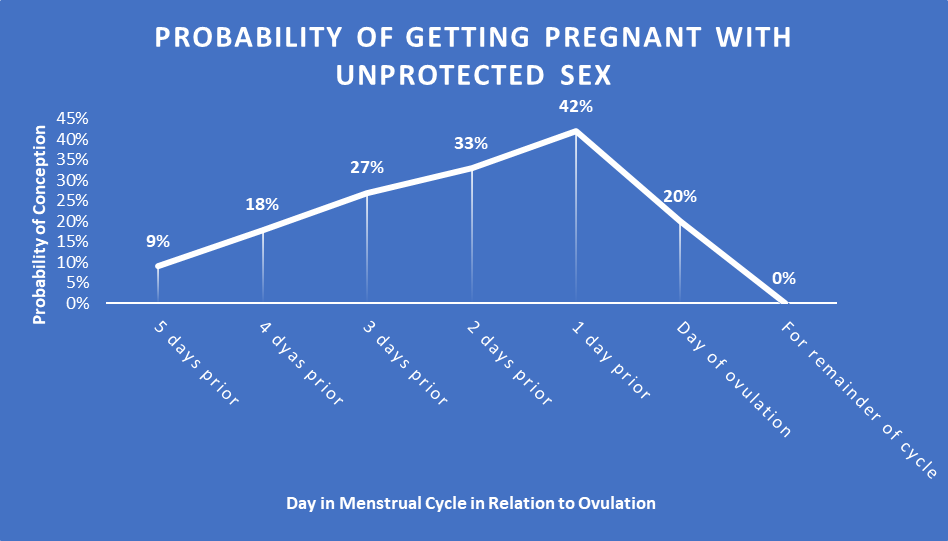
Additionally the probability of getting pregnant from unprotected sex for each day within the fertile window is as follows:
Conclusion

Overall, there are only a total of 6 days within a woman’s cycle in which she can conceive. However, of these 6 days, she is more likely to get pregnant on some than others. The days she has the highest chance of conceiving are the two days prior to ovulation.  Therefore, it is not only important for a couple to identify the day of ovulation, but also to be able to identify signs and symptoms of high fertility, which indicate a woman is within her fertile window.

References:

https://www.fertstert.org/action/showPdf?pii=S0015-0282%2819%2930432-7

https://my.clevelandclinic.org/health/articles/23439-ovulation

The BasicsPregnancy & PostpartumFertility

About the author

Dr. Rachel Regan, MD — My name is Dr. Rachel Regan. I am a board-certified family medicine physician with training in full spectrum family medicine. This means that I have experience in treating all ages (newborns to geriatrics) as well as obstetrics and gynecology. However, as a Catholic physician, I have a special interest in NFP (Natural Family Planning) and using it to help diagnose and treat different women’s health issues such as irregular cycles, PMS, and infertility.

Read more about Dr. Regan →

This post may include affiliate links. If you click one of them, I may receive a small commission at no extra cost to you. Thank you for your support!

Keep reading

Why Day 21 Labs Don’t Work: How NaPro Technology Offers a Better Alternative to One-Size-Fits-All Hormone Testing
Fertility

Why Day 21 Labs Don’t Work: How NaPro Technology Offers a Better Alternative to One-Size-Fits-All Hormone Testing

Why standard day-21 progesterone labs can miss the mark, and how NaPro-timed testing gives a clearer picture of your hormones.

May 27, 2025·4 min read
Bioidentical Oral Progesterone vs. Wild Yam Progesterone Creams
Fertility

Bioidentical Oral Progesterone vs. Wild Yam Progesterone Creams

How bioidentical oral progesterone compares with wild yam creams - what each does, the evidence, and questions for your clinician.

March 20, 2025·5 min read
What Do Physicians Actually Learn About NFP in Medical Training?
The Basics

What Do Physicians Actually Learn About NFP in Medical Training?

An honest look at how little natural family planning is covered in medical training - and why that gap matters for patients.

January 7, 2025·7 min read

Free Handout

Get the free “Irregular Cycle Identifier”

Not sure if your cycle is normal? Subscribe and I’ll send you my free handout to help you spot the signs of an irregular cycle.